
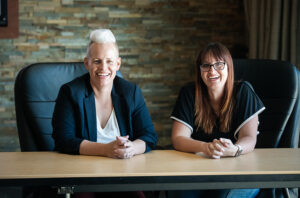
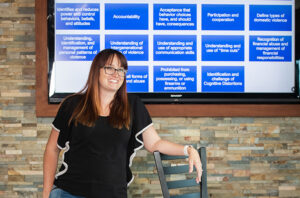
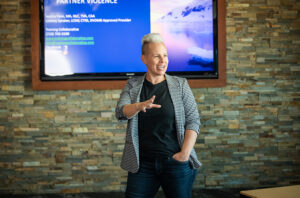
We found a purpose for helping others through passion and personal experience. Meet the passionate professionals who co-founded the Training Collaborative.
‘You could say the first time I knew I would work in victim advocacy someday was the first time I met with an advocate. ‘He WILL kill you,’ she said. ‘I have seen it time and time again. I know where this story is going. If he started this bad, he WILL kill you.”
-Jessica Fann

I was 19. It was my one-month wedding anniversary. We had giddily gone to the courthouse and gotten married in secret. He bought me flowers almost weekly. He fussed over me, always wanted to know where I was, wanted me with him all the time, dropped me off and picked me up from work, helped me pack my lunch, and helped me pick my outfits. He was every bit of the doting boyfriend I had craved. Someone who loved me passionately, someone who couldn’t live without me.
I longingly looked at the picture broken on the floor. He had thrown our bookshelf to the ground, breaking everything on it. I had spent hours putting together that bookshelf in our living room trying to make the apartment look like a home. The photo of my parents and me at my high school graduation glared back at me.
That familiar pit of loneliness I felt as a child settled in my stomach. The one I felt when they screamed. The one I felt when he was high, drunk or otherwise occupied. The one that felt like home when her anger transformed her into a monster I was never equipped to fight. I knew why this felt normal at that moment.
Holding an ice pack to my head while waiting for the police and paramedics to leave, I told her I would be fine, I just needed to figure it all out. She was much older than I was. Her eyes were heavy with worry. Her shoulders sagged as I told her I was fine, and she could go. She handed me her business card and said I could call anytime. I began picking up pieces of the television, the door frame, my cellphone and just cried.
Let me be clear. I got out. I was lucky. Despite numerous beatings, social isolation, financial ruin, and endless moments of emotional abuse, I got out. We had no children. I was divorced, bankrupt, and had just become old enough to legally drink. But. I. Got. Out.
That was in 2000, the same year the Domestic Violence Offender Management Board was created and a year after the Victims’ Rights Act had just passed in Colorado. The system for victims was just getting started. He was ordered to Anger Management and offered a deal after I summoned the courage to testify against him twice. He went on with his life. I suffered the consequences of his behavior for two years as he harassed and intimidated me through the process.
Restraining orders were not adhered to. Police rolled their eyes at me each time I filed another report. I was told to give up and “let him go.” I was told I was being dramatic. I showed up without attorneys to everything. He had high-price lawyers his parents paid for.
The lesson I learned was that the victim didn’t matter. We simply needed to process this guy through the system and get on with the next. I needed so much more than I was given. I walked away not even understanding I had been a victim of domestic violence.
So I moved on. I gathered an undergraduate in Elementary Education, hoping to teach. Then a Masters in Forensic Psychology. I met a kind man, married, had three children and worked my way meticulously into social services while always keeping the focus on my kids. I worked as an investigator for a Family Law office, Caseworker, Therapist, Trainer, Advocate—Advocate… that word. Advocate.
I realized that was what woke me in the morning. Advocating for the underprivileged. Advocating for children. Advocating for victims. Advocating for educational rights. Advocating for the right to love who you want, to be who you want, and to exist how you want. Advocating for safety for all humans, regardless of their ethnicity, ability, background, social class, age, color, sexual orientation, experiences, or whatever it was that had set them apart and made the world feel justified in pushing them to the side. Advocating for the oppressed.
Then it happened. I looked back and realized that if the world were trained to understand, even at an academic level, what it meant to SURVIVE, then there would be less of a need to advocate. My why is to work myself out of a job. I know Domestic Violence at its core. I have worked in Domestic Violence in some fashion for 14 years and I felt it deeply, personally.
I see professionals floundering to help but not knowing what they don’t know. I am here to give you what you don’t know so each victim you encounter can become a survivor, with your help. But advocating doesn’t stop there and domestic violence is just one topic. I know we have a lot of work to do and I’m all in. I hope you join us at our table.
“‘For me, Training Collaborative was born from the realization that if the training doesn’t exist, let’s stop talking about the problem and do the work.'”
-Lindsey Spraker

In our fields we crave education, but more so, we crave education that is accessible, relatable, and current. I love reading research – true statement – but find it inaccessible or cumbersome to comb through, assess, and apply to my work without intensive time in with each document that my schedule may not
often have room for.
Solution: Training Collaborative partners with researchers to share research briefs that are current, informed, and relevant
to our practice.
Another problem that exists is the lack of findable” expert trainings on the complex and dynamic issues of today’s community needs, treatments, systemic changes, and barriers.
Solution: Training Collaborative provides these trainings in one place. Less searching. Less dead ends. More access. Time saved. Done.
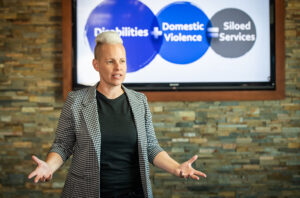
I would be remiss to not mention what was the true kick starter of my journey. As a therapist who specializes in working with clients with disabilities ranging from intellectual to learning to brain injuries to autism spectrum to disabilities not yet diagnosed, I discovered something. My clients were discharged unsuccessfully from other community agency services at a higher rate than most. The one that stood out to me was specifically domestic violence treatment.
My solution: Get trained as a domestic violence treatment provider, so I would personally provide treatment to clients in the way they best learn. And so I have. Subsequently, the unsuccessful discharges declined, clients with nontraditional learning needs were successful, and unjust reincarceration of clients with disabilities decreased. Again, this was part of my “close the gaps, do the work” mentality. And results were evident. I then realized an expansion of exciting opportunities to close the gaps in other areas of treatment, education, and professional development which aligned seamlessly with Training Collaborative.
The final problem that brought me to the table was access in terms of financial equity. As a white woman committed to equity and diversity efforts, I believe it is my duty to actively participate in restitution efforts and pathways to close the gaps of education and training access to learners whose communities have been historically oppressed, overlooked, or ignored.
Solution: The creation of a nonprofit mindfully named Professional Collaborative which provides scholarships and funding to close the gap of inequity, access, and diversity for many of the most expert, qualified, and passionate people yet to be discovered.
I am honored to be a part of the Training Collaborative and can’t stop-won’t stop closing the gaps for those who journey alongside us. Take a seat at the Training Collaborative table. I saved you a spot.
So how did two professionals with very different WHYS come together? Our first encounter was a perfect storm. Passion, purpose, and perseverance collided in ways that we knew working together was destined. We have a Never Quit attitude with a healthy splash of Imposter Syndrome.
We’ve experienced professional highs and professional lows (*cough* pandemic) both together and separately but our paths continued to collide. Years of us working together in the same system, in different systems, and finally, with our passions crossing between the offender and victim sides of treatment, systems, and processes. One theme kept emerging. Cross-Training.
Each time a case hit a wall, a client became entrenched in a lack of accountability, a victim felt powerless, or a family was disappointed, there was a common theme. There was a lack of training in one or more of the professionals involved.
How do you politely tell a professional that their lack of knowledge is a barrier? How do you have a conversation with someone with the goal of training them, without them feeling like you are talking down to them? How do you explain your role to a member of your team so they can come along beside you in your understanding of the family, knowing your boundaries and practices?


This is how the Training Collaborative was born. The real lightbulb went on when we tried to make the list of professionals we should target for training.
The answer is YES. Yes to it all. We know we are not alone. We know that every time we have experienced a barrier in our line of work, there are likely dozens more professions needing the same level of support, interventions, or trainings.



We offer a variety of opportunities for professionals interested in enhanced training and certifications.